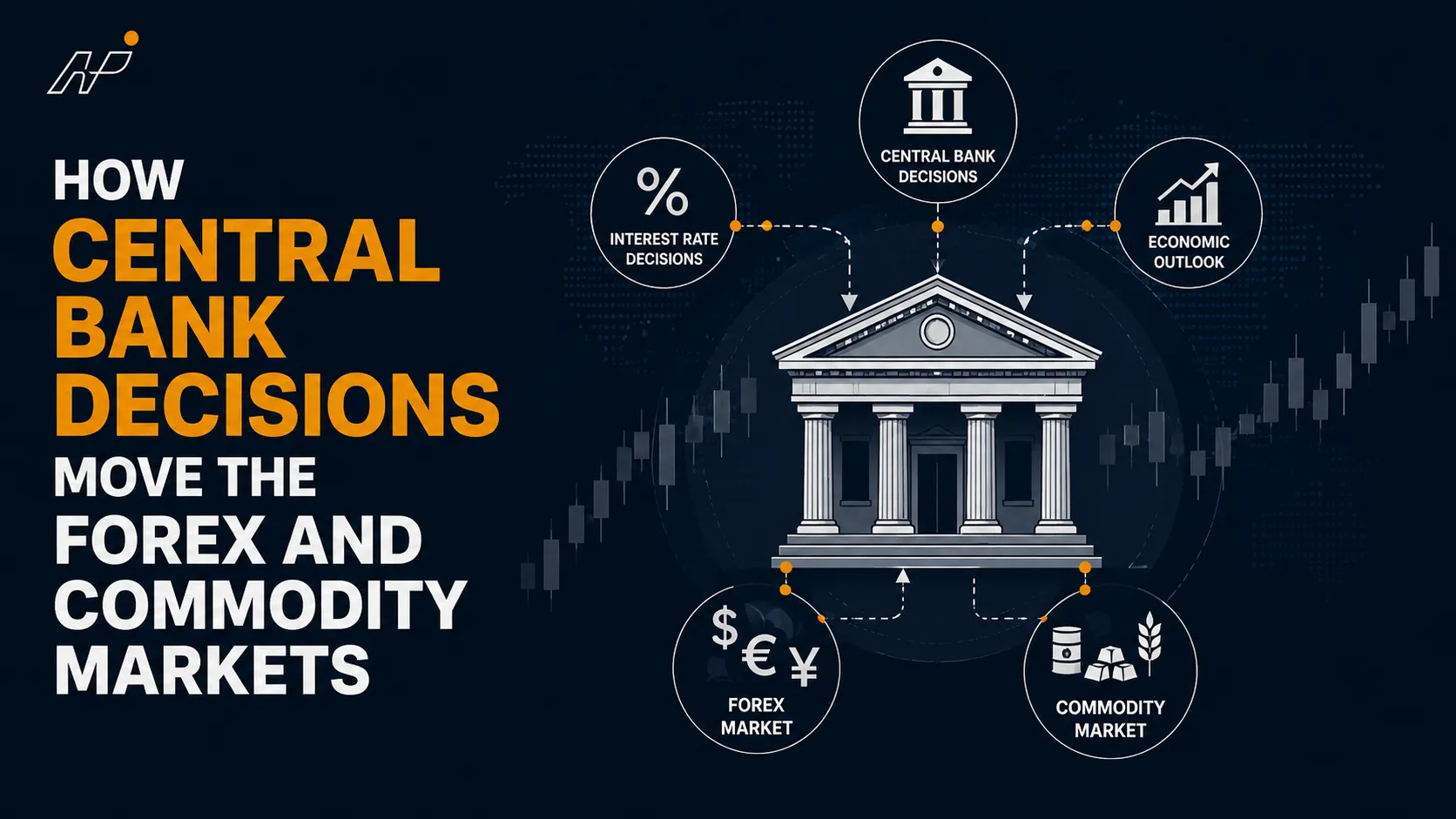
How Central Bank Decisions Move the Forex and Commodity Markets
Central banks are the single most powerful force in the global financial markets. Their decisions on interest rates and monetary policy create immediate and sustained movements across forex pairs, gold, bonds, and equities. Every serious trader must understand how central banks operate and how to position themselves around their decisions. Central banks — such as the U.S. Federal Reserve (Fed), the European Central Bank (ECB), the Bank of England (BoE), and the Bank of Japan (BoJ) — are responsible for managing a country’s money supply and interest rates. Their primary goals are to control inflation and maintain economic stability.
Core Monetary Policy Actions:
Rate Hike (Tightening): When a central bank raises interest rates, borrowing becomes more expensive. A rate hike typically strengthens the country’s currency (higher rates attract foreign capital) and is bearish for gold (higher rates increase the opportunity cost of holding a non-yielding asset).
Rate Cut (Easing): When a central bank cuts interest rates, borrowing becomes cheaper, stimulating economic activity. A rate cut typically weakens the country’s currency and is bullish for gold.
Forward Guidance: Central banks communicate future policy intentions through speeches, meeting minutes, and press conferences. A hawkish (rate-hike leaning) tone strengthens the currency; a dovish (rate-cut leaning) tone weakens it.
Key Events and Volatility
Key events to watch: FOMC meetings (8 per year), ECB meetings (8 per year), BoE meetings (8 per year), and BoJ meetings (8 per year). The most important events are not just the rate decisions themselves but the press conferences and statement language that follow. These dates are available on the AP economic calendar.
The most common trading mistake around central bank events is trading the announcement itself. Prices often move sharply in one direction and then reverse — this is called “buy the rumour, sell the news.” More experienced traders wait 15–30 minutes after the announcement, then trade in the direction the market establishes after the initial volatility settles.
Key Takeaway: Central bank decisions are the most powerful fundamental force in financial markets. Track central bank meeting dates on your economic calendar, understand the direction of monetary policy, and align your trades accordingly.